Email outreach still matters in 2026 – but it has evolved!
So, are you planning to skyrocket your pipeline growth in 2026? It is the right time to rethink how you approach email outreach.
As inboxes have become highly competitive, buyers are looking for relevance, value, and clarity at every touchpoint; businesses can no longer rely on volume-driven tactics to capture attention. To be precise, the long‑standing B2B practice of mass email blasting is no longer effective or capable of delivering meaningful results.
This guide presents a solid email outreach framework, alongside the strategies B2B marketers can implement to get faster pipeline growth in 2026. Let’s get into it.
Introduction to Email Outreach
Email outreach is basically a method of communicating with people via email. It stands as an ideal and effective way to reach out to people, rather than the traditional approach of cold calling, in-person meetings, personal networking, and more.
Email outreach helps reach customers who are unaware of your brand, show no keen interest, but may later convert into potential customers and generate business leads.
Whether you’re a startup, founder, or marketer looking to boost your business revenue, email outreach can be a grand champion in making the most of your efforts.
Why Cold Email Continue to Work in 2026?
Yes, in 2026, the cold email is not dead yet — but when done properly. It is all about quality, purpose, and relevance. It no longer matters how many generic messages are sent to the inbox; it is rather outreached that is focused, considered, and appeals to the appropriate prospects.
Myth vs. Reality
Myth: “Cold email is dead.”
Reality: Untargeted, impersonal cold email is dead. Nevertheless, intent-based personalized cold email is more efficient than ever.
The Solid Email Outreach Framework for 2026
Here’s an email outreach framework that you should follow to unlock super-fast pipeline growth in 2026.
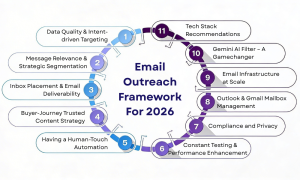
1] Data Quality & Intent-driven Targeting
Wrong data yields wrong results! Data quality is the foundation of every successful email outreach campaign. If your contact information is outdated, incomplete, or incorrect, even the most powerful messaging cannot be achieved.
In 2026, productive teams would focus on confirmed work email addresses, correct firmographic information, and updated job positioning.
In addition to the actual data, intent signals, e.g., visits to websites, downloads of content, hiring trends, or competitor research, can be used to target prospects who are actively considering solutions.
- Authenticated work emails and the position of the decision maker.
- Proper industry, company size, and revenue information.
- Proactive purchase indication and purchasing intention.
Indeed, data hygiene is the cornerstone of a top-performing outreach model.
2] Message Relevance & Strategic Segmentation
Segmentation makes cold outreach meaningful. Rather than sending a single generic message to an entire list, outreach can be customized to the prospect and their position in the purchasing process.
Best segmentation takes into consideration firmographics, role and persona, engagement history, lifecycle stage, and product usage patterns. The following are a few segmentation variables for B2B:
- Role defining (CMO vs CTO vs CFO)
- Lifecycle segmentation (awareness, consideration, decision)
- Interaction-based segments (active vs inactive prospects)
In scenarios where messaging is tailored to a prospect’s needs, the outcome will be impressive. According to data, segmented email campaigns can drive 30% more conversions and 50% click through rates.
3] Inbox Placement & Email Deliverability
Email deliverability is the percentage of emails that arrive in the inbox. One bad placement of inboxes, poor outreach is killed softly and without saying a word. This model focuses on inbox protection through proper domain authentication, the domain warning process, and monitoring the sender’s reputation.
How to improve your email deliverability?
- Authenticate your domain: SPF, DKIM, and DMARC.
- Keep sender’s reputation: Maintain bounce rates below 2%, compliant rates below 0.1%.
- Warm up your sending domain: Gradually increase sending volume to build trust with inbox providers and avoid sudden spikes.
- Practice a strict list of hygiene: Regularly remove inactive, invalid, or unengaged contacts to reduce spam signals and improve inbox placement.
4] Buyer-Journey Trusted Content Strategy
Email messages should align with the buyer’s stage in the decision-making process. First-time buyers are the ones who respond best to educational insights and industry trends, while middle-funnel buyers interact most with case studies, webinars, and comparison materials. Decision-stage prospects require proofs like demos, ROI calculators, and reviews.
- Awareness: knowledge, trends, training.
- Consideration: webinars, case studies, guides.
- Verdict: demos, ROI demonstration, social validation.
Content equals intent, which translates into more engagement and shorter sales cycles. Messaging that aligns with buyers builds trust and accelerates the pipeline.
5] Having a Human-Touch Automation
Automation allows scale and human tone to engage. The outreach must be supported by AI and automation tools , and not authenticity. They can be applied to follow-ups, lead scoring, task routing, and A/B testing, whereas messaging is conversational and written by humans.
- Automatic sequencing and follow-ups.
- Personalization and testing with the assistance of AI.
- Human-led messaging and tone
Robotic emails are easily identified by the buyers, and this decreases the trust and response rates. Loyalty market in 2026 in the winning strategy is efficient and empathetic.
6] Constant Testing and Performance Enhancement
Outreach programs that perform well do not remain the same. Campaigns are refined as time goes by through continual testing and optimization. Revenue metrics, and not vanity metrics, must be tracked by teams.
What should you test?
Nearly all parts of your e-mail:
- Topics: They determine whether your email will be opened or not.
- Opening lines: The initial few seconds that either make the reader continue the passage or erase it.
- Call to action: Do you want a response, a call, or another action?
- Send times: Does your audience respond in the morning of the week or the later part of the day?
7] Compliance & Privacy
In 2026, compliance and privacy are no more optional for email outreach; they are key drivers of deliverability, inbox placement, and buyer trust. Certain regulations such as GDPR now directly influence how mail providers evaluate the sender’s reputation. A privacy-by-design approach simply goes beyond legal compliance and play a major role in ensuring emails land straight in the inbox rather than spam.
Following are some of the important regulations that needs to be followed:
GDPR (EU): Governs how personal information is gathered, processed, and stored, requiring a legally justified right, transparency, and user consent. Failure to comply with may have a direct consequence on the sender’s reputation and lead to heavy penalties.
CAN-SPAM (US): Regulates business communication via email by requiring the sender to provide true sender information, honest subject, and clear opt-out so that the recipient is not harassed by unsolicited mail.
DPDP Act (India): (Digital Personal Data Protection Act, 2023) An act that provides the processing of digital personal data in both manners, to protect their personal data and need to process personal data for lawful purpose.
PECR and other regional laws: Regulate electronic communications, cookies and marketing consent, in particular B2B and B2C outreach in particular regions.
Best Practices in Compliance that enhance Deliverability
Outreach based on compliance can not only help to prevent penalties but also boost senders’ trust, brand credibility, and email performance. To win safe and successful email campaigns, it is essential to follow some of the best practices:
- Clear Sender Identity: Emails need to be sent from an authenticated, valid business domain using a recognizable sender name.
- Clear subject lines: Do not use deceptive, misleading subject lines that are activated by spam filters.
- Legal data usage: Keep proper records of data sources, consent, or lawful interest.
- Easy opt-out: Include noticeable and workable unsubscribe options in all emails.
- Proper data management: Only applicable and current contact data in accordance with the aim of outreach should be used.
When compliance becomes the primary element in your email outreach strategy, not just merely obligatory, you manage to enhance inbox placement, establish trust over time, as well as produce pipeline growth that is sustainable.
8] Outlook & Gmail Mailbox Management
Effective Outlook and Gmail mailbox management is crucial for handling email outreach at scale in 2026. As reply volumes grow, teams must focus on speed, ownership, and organization in order not to miss a single chance. Well-maintained inboxes enhance the speed of response, co-work, and experience with prospects directly affecting the conversion of pipelines.
Microsoft Outlook comes with features such as Folders, Rules, Quick Steps, and shared mailboxes to enable teams to direct and reply to emails effectively. Gmail offers stand out tags, search, filters, intelligent replies based on AI, and delegate emails to facilitate quicker triage and follow-ups.
Top Practices for Managing Replies at Scale
- Create folders (Outlook) or labels (Gmail) to organize emails by status including new leads, follow-ups, booked meetings and closed conversations.
- Configure rules and filters to automatically redirect, rank or file received messages by sender, topic or purpose
- Use shared inbox or mailbox delegation allowing teams to work together, not write emails twice, and keep clear ownership.
- Abide by a two-minute response guideline when dealing with prospects that have high intent- speed of response largely affects conversion rates.
- Store rather than delete the emails to keep clean in-boxes and retain the history of the conversation.
- Connect email and calendar applications to arrange meetings with less time and eliminate time-wasting communication.
9] Email Infrastructure at Scale
Email outreach does not only involve increasing the number of mails sent but rather establishing the necessary infrastructure to preserve the deliverability, reputation and response rates as volumes rise. Even the most reasonable messaging would never get to the inbox without a solid infrastructure.
The following are a few important points when it comes to email infrastructure at scale.
Separate Sending Domains
When engaging in email outreach on a scale level, it is necessary to use specific sending domains.
Organizations aim to make distinct subdomains or domains that are solely used in outreach instead of sending large volume messages under your main corporate domain.
This approach:
- Guarantees your core brand name security against deliverability issues.
- Allows volume and messaging to be experimented with.
- Ensures that internal or transactional emails are not influenced by sales or their marketing campaign.
Domain Warm-Up Strategy
Domain warm-up is the process of slowly gaining confidence with inbox providers and then increasing volume.
An effective warm-up plan contains:
- Less emails are sent on a daily basis.
- Only relevant emails will be sent and customized.
- Focusing more on responses and interaction than quantity.
- Increasing progressively in 24 to 4 weeks.
One of the quickest triggering spam filters is to skip or hurry warm-up. Correct warm-up sets legitimacy, consistency and reliability of the senders to the mailbox providers.
Reputation Management and Scaling Best Practices
A few key practices that stand as a gamechanger for your reputation management and scaling:
- Staying in regular patterns of sending.
- Measuring the bounce rate, spam complaints, and replies.
- Eliminate dormant or idle contacts on a regular basis.
- Audiences’ segmentation to make the message relevant.
Why Infrastructure is Critical for Outreach Success?
Infrastructure plays a key role in the success of outreach as it directly impacts whether emails arrive in the inbox, are prioritized, and respondents receive. The most eloquent messaging will not work in case of lack of sending domains, warm up processes, authentication, and reputation management.
With the increase in the outreach volume, mailbox providers pay close attention to the sender’s behavior, interaction patterns, and consistency. The robust infrastructure will guarantee reliable deliverability, brand trust and long-term contact, and outreach teams will create pipelines in a predictable fashion, not struggling with spam filters or degraded performance.
10] Gemini AI Filter – A Gamechanger
Gmail is now coming to the Gemini era, being your personal, proactive assistant. Gmail’s new Gemini AI filter is a significant move in how emails are evaluated, ranked, and surfaced in the inbox. It analyzes emails according to the context, engagement, relevance, and originality, rather than traditional rule-based filtering and keyword matching. For outreach teams, this marks the end of volume-first email strategies and the beginning of relevance-led communication.
Gemini features, including AI Overviews, conversation-level understanding, and AI-driven Inbox prioritization means users will see what actually matters first. Gmail does not bury messages with potential intent and personal interest, but rather displays emails with evident purpose, individual significance, and often actual value.
How Gemini AI Prioritize Emails?
The Gemini AI of Gmail uses various indicators to assess the importance of an email:
- Relevance: Correlation with the role, behavior and previous interactions of the recipient
- Moderateness: No standard word patterns rather than standardized phrasing.
- Enhanced: Reply, forward, time to read, and history of interaction.
- Quality of conversation: Natural, non-salesy or automatic message.
Depending on the timeliness, personalized, and usefulness of the emails, they have a higher chance of being surfaced as important.
Reasons why Generic or Repetitive Emails are Filtered
Gemini is very efficient when it comes to identifying mass patterns of outreach. Emails that rely on, reused templates, overused sales phrases, minimal personalization and elevated volume-low response signals are soon categorized as low-value outreach. Such emails are not sent to spam, but they are prioritized lower in the feed than more important conversations or not shown at all under the Important label.
Concisely, no longer can volume-first outreach be effective in a list of inbox that is AI-ranked.
The Secret to Writing Emails that Beat AI-based Filters
In order to succeed in the AI-oriented world of Gmail, outreach should be highly goal-oriented and human-centered:
- Make it more personal than first-name tokens – make allusions to actual situations.
- Compose brief, exclusive subject lines and text.
- Concentrate on a single idea or problem in a single email.
- Promote natural responses rather than violent CTAs.
- Behaviors and engagements are consistent.
11] Tech Stack Recommendations
It’s no surprise that organizations are spending more on technology than years before. In 2026, the email outreach system is incomplete without the appropriate technology stack functioning as an integrated system. This is about tools that work together complementarily to enhance the quality of data, deliverability, personalization, compliance, and revenue attribution.
Some of the key features of a solid outreach stack include correct, intention-dense data, a reputation-safe sending stack, compliance with design, rapid and coordinated inbox processing, and a circle of life with pipeline-level analytics.
The layers strengthen each other, as the one weakened ruin the whole machine.
Data & Intent Layer
The success of the Outreach starts with the contact and the reason why.
This layer combines:
- Check contact and account information between businesses.
- Intention to buy and company intention.
- Cues are installed on websites and technology
Quality data and intent guarantee the timeliness, relevancy and synchronization of outreach with actual buying signals- minimize noise and enhance engagement prior to the first email being dispatched.
Sending Layer & Deliverability Layer
This layer defines the positioning of inboxes and reputation of senders. It includes
- Sales engagement/ ESP platforms.
- SPF, DKIM, DMARC Proper authentication.
- Continuous domain and reputation health monitoring
- Preparations on inbox trust indicators such as BIMI.
This stack, when coupled with the data layer, makes sure that emails are safely sent, sent on a consistent basis, and in large volumes without harming deliverability.
Compliance Layer
The compliance must be incorporated into the outreach workflows, which must not be introduced as a secondary consideration. This layer provides smooth management of unsubscriptions, preference centers, audit logs, and consent tracking as well as can support regional compliance needs, including GDPR, CAN-SPAM, and other laws.
Effective compliance ensures credibility of the brand, decreases legal liability and messages of trustworthiness to the mailbox service providers and recipients, which promotes long-term outreach performance.
Inbox & Triage Layer
Pipeline is created where reply is sent, and speed is important. Sound management of the inbox will make sure that no reply is skipped, the response time remains low, and the discussions flow smoothly to the meetings.
This layer focuses on:
- Native delegation (Gmail or Outlook) or shared inboxes.
- Crash avoidance and ownership of transparency.
- Quick-response workflows and templates.
Revenue Attribution Layer Analytics
The last layer is what links the outreach activity to the performance of the business. It supports CRM-based reply and meeting attribution, opportunity and pipeline movement, and offers straightforward visibility of outreach-driven win rates and revenue with special dashboards. This closes the loop of moving the outreach measurement beyond the vanity metrics such as opens and clicks to something that has a purpose in measuring pipeline impact and revenue contribution.
Why Stack Alignment Matters?
There is no outreach performance that is an isolated phenomenon in 2026. When data, deliverability, compliance, inbox management and analytics collaborate, teams will have predictable placement of inbox, better-quality conversations and measurable revenue impact.
Not only does the right tech stack facilitate outreach, but it also enhances it.
Additional Email Outreach Strategies to Implement
1] Make the Subject Lines Catchy
It’s said that an email subject line is the first way to impress the recipients. So, make sure it’s catchy and convince them to open the email. The success of your email open rate mostly depends on the subject line you’re writing. Be it a generic email, an offer, a deal, etc. As per stats, personalized subject lines are 26% more likely to convert than generic ones.
2] Focus on Call-to-Action
Call to Action (CTA) plays an important role in your email outreach strategy. According to reports, a CTA can increase click-through rates by 30-35%. This is why it is necessary to craft powerful CTAs that drive users to take the following action.
3] Follow-ups that Add Value
The key to outreach success is follow-ups. Make sure to send 2-3 follow-up emails, with one that adds value. A well-crafted follow-up email can yield strong results and improve your conversion rate. To build trust, add a blog link, a case study, or similar.
Top Outreach KPIs tied to Pipeline and Revenue
The top sales KPIs showcase your team’s unique goals and business models. Following are a few important outreach KPIs you should track to get a closer idea of your efforts.
Core Pipeline KPIs
1. Meetings Conversion Rated Leads – The leads-to-meetings conversion rate indicates how your team converts leads into sales meetings and takes the prospects down the funnel.
2. Meetings to Pipeline Conversion Rate – Displays meeting turnover into opportunities in percentages.
3. Deal Win Rate – Shows the percentage of opportunities that are successfully closed in the form of won deals.
4. Pipeline Velocity – Knows the rate of transfer of revenue through the pipeline.
Core Revenue KPIs
5. Monthly Recurring Revenue (MRR) – The monthly forecast revenue from customers.
6. Customer Acquisition Cost (CAC) – Calculates the mean price of obtaining a new customer.
7. Customer Lifetime Value (LTV) – It is an estimate of the total revenue a customer is likely to spend over a lifetime.
How Email Outreach Contributes to Pipeline Velocity and Deal Conversion?
Email outreach helps increase pipeline velocity and deal conversion by enabling timely, consistent, and personalized engagement with prospects throughout the buying journey.
By using structured follow-ups and tailored messaging, sales teams can reduce response delays, keep opportunities moving through each stage, and build trust with multiple stakeholders. Educational and value-driven emails also address objections early, improving buyer confidence and increasing the likelihood of closing deals faster and more efficiently.
Common Email Outreach Mistakes to Avoid
Even with the correct approach, minor errors can damage your cold outreach. Be careful of the following mistakes:
Sending too Many Follow-ups
Know when to stop. More than three follow-ups are pushy, not supportive.
Talking about what you like, not what they need
What customers cherish might not interest prospects. Focus on their problems.
Neglecting email signature
It is always a good idea to add your name, position, company, and contact information—trust matters.
Selling features rather than outcomes
Prospects are not interested in features; they are interested in results such as saving time or boosting income.
Wrapping it Up!
In 2026, email outreach is about quality, not quantity. Emphasize intent-driven, non-polluted data, strategic segmentation, excellent deliverability, and content that aligns with the buyer. Automate to go big with a human touch, test constantly, and follow up on value. Don’t make common mistakes like following or selling features rather than results.
Email can be a powerful tool for expanding your pipeline, building trust, and making money with a strategic, data-driven approach.
Kick starts your email outreach journey with the best B2B lead generation company, CandorWorks and watch your business soaring high!