B2B Martech Trends 2026 are redefining how organizations understand audiences, personalize engagement, and drive sustainable B2B growth. One thing in marketing that no organization can ignore is the need to identify the exact needs of the target audience. This surely helps build trust and reliability, boosting sales in the broader sense. B2B marketing has undergone major shifts in recent years, focusing on business needs rather than just filling sales pipelines.
As B2B marketing becomes more audience-focused, 2026 will surely see the dominance of strategies that enable organizations to better understand their audiences. Alongside that, precise targeting, maximized reach, and innovation will have significant attention.
In this blog, we’ll understand what B2B marketing holds in 2026, and which changes will be transformative in the first quarter of the year.
Firstly, let’s get a detailed overview of the B2B marketing ecosystem in 2026.
An Overview of B2B Marketing in 2026
Business-to-business marketing is a complex process for achieving set goals and preserving long-term growth. However, effective strategies can yield fruitful results when successfully executed. In B2B, effective marketing is crucial and ultimately drives sales goals.
Unlike B2C marketing, which typically involves shorter sales cycles, B2B marketing involves longer sales cycles and focuses on long-term relationship building. Hyper-personalization and intent-based targeting have already ruled B2B marketing in 2025 and earlier.
Hence, 2026 will see more innovation and a targeted approach as it makes a mark in the B2B industry.
B2B marketing in 2026 will combine innovation with orthodox approaches to drive more success. Such an approach will support marketers from the beginning, as they discover the right audience, drive conversions, and move into sales. Enhanced flexibility and adaptability will be crucial for this purpose.
Gone are the days when B2B marketers adopted one-size-fits-all strategies. At present, an audience-focused approach alongside automated processes is offering higher efficiency. Hence, it will be crucial to see how B2B marketers merge automation and an audience-focused framework while overcoming marketing challenges.
5 B2B Martech Trends 2026 Redefining Q1 Marketing
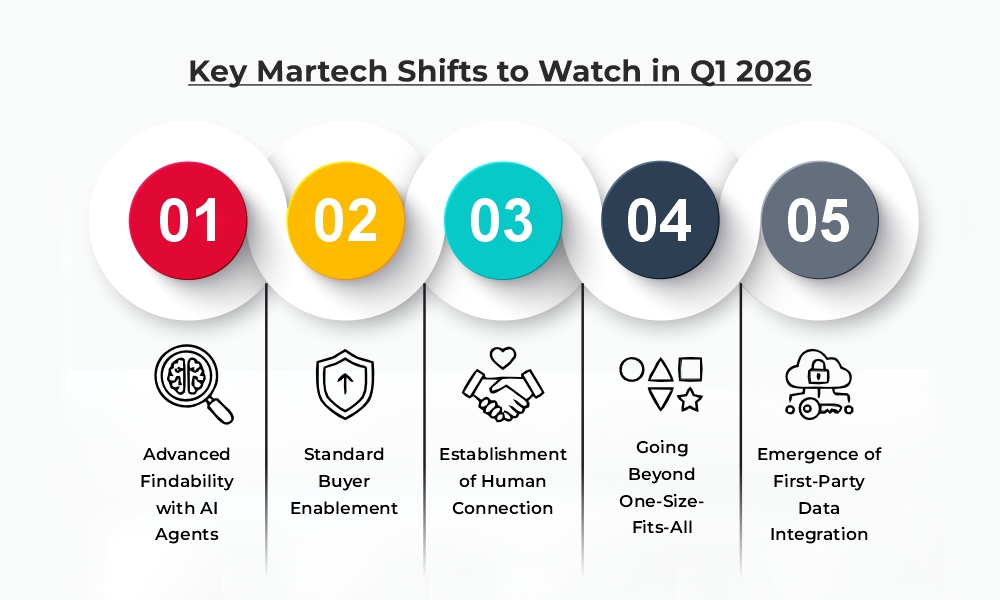
- Advanced Findability with AI Agents
- Standard Buyer Enablement
- Establishment of Human Connection
- Going Beyond One-Size-Fits-All
- Emergence of First-Party Data Integration
The first quarter of 2026 will be crucial for B2B marketers to create and maintain the momentum that continues throughout the year. Here are some key shifts to check out.
1] Advanced Findability with AI Agents
B2B organizations depended on intent data and account-based strategies for years to boost their findability. However, in the first quarter of 2026, findability will find support in automation led by AI agents.
Identification of high-value prospects alongside hyper-personalization and competitive intelligence; AI agents automate all the functionalities, preserving efficiency. Data states that over 78% of B2B companies already use AI for several functionalities. However, findability is an important area that has been challenging for B2B firms. Hence, adopting AI agents while targeting the appropriate audience will surely be a remarkable step for B2B marketing in Q1 2026.
Real-world Use Case
A B2B SaaS firm encounters challenges with finding the right audience for their business, despite having thorough experience in the industry. To address the situation, the organization integrated discovery and enrichment agents, helping the organization remarkably.
The discovery agent helped the firm to scan and identify profiles automatically, assessing their job profiles and intent signals. On the other hand, the enrichment agent helped in automating accounts and contact records for enrichment.
Outcomes Observed
- Advanced ideal customer profile creation
- Precise audience identification and targeting
- Impactful lead generation and conversion
- Increased growth and ROI
2] Buyer Enablement Turning into a Crucial Component
One of the significant challenges B2B marketers face in 2025 is appropriate buyer enablement. It defines the deliverability of the right information, experience, and insights throughout the buyer journey. Buyer enablement helps prospects in research and better decision-making.
In the first quarter of 2026, effective buyer enablement will be crucial, leading brands to deliver the right information about their services to help buyers make better decisions. Furthermore, it offers customers an enhanced digital experience. In case of misleading insights, customers can penalize companies at any time.
Real-world Use Case
One of the leading cloud providers failed to convert leads into paying customers even after impactful nurturing. As a result, the firm encountered unmet conversion goals and growth. To address this challenge, the company adopted a thorough buyer enablement strategy, understanding the requirement to deliver the right information at the right time to its audience.
The components created and utilized are stakeholder playbooks, relevant whitepapers, and post-sale confidence kits. Alongside that, the firm attained third-party references on online assets for enhanced trust. Such an approach to buyer enablement helped in gaining and maintaining audience trust throughout the sales funnel and beyond that.
Outcomes Observed
- Improves buyer experience
- Enhanced trust and credibility
- Reduced buyers’ remorse
3] Human Connection Becoming a Key Aspect
Automation is necessary to streamline multiple functionalities. However, establishing human connections with audiences is equally important. It builds trust and helps marketers understand the exact needs of their audience. Business leaders often overlook automated messages and robotic approaches. As a result, marketers fail to generate quality leads and convert them.
Human connection impacts interaction with audiences remarkably. In other words, human intelligence in conversations drives empathy and credibility. Here, the emotional aspect plays a significant role and establishes credibility with audiences. Therefore, in 2026, it will be important to observe how B2B marketers combine automation and human connection while building long-term relationships with their audience.
Real-world Use Case
As a part of digital transformation, a marketing firm automated most of their operations with AI, from audience segmentation to creating engagement. As a consequence, the firm gradually lost the engagement rate in their marketing initiatives, impacting their sales targets.
A strategic approach streamlined their marketing initiatives by combining AI automation with human intelligence. It helped the firm regain their audience’s trust, alongside improving communication with them.
Outcomes Observed
- Refined communication and engagement
- Trust and empathy establishment
- Preserved customer loyalty
4] Market Reach Expansion Beyond One-Size-Fits-All Approach-B2B Martech Trends 2026
B2B marketers continually take initiatives to expand their reach, using multiple channels simultaneously. Traditionally, market reach expansion in the B2B industry relied heavily on email. Contemporarily, the B2B audience is scattered across diverse mediums, including digital channels, industry-specific hubs, supplier networks, legacy marketplaces, and others.
Each platform carries specific characteristics. While marketers find strong matches in industry-specific hubs, legacy marketplaces include audiences with diverse needs. Hence, B2B marketers need to go beyond a one-size-fits-all approach, personalizing content, messages, and touch points according to audiences’ needs.
Real-world Use Case
A leading automation platform failed to expand their reach even after assessing market demand for their product. The challenge they faced was the inability to scale their product for different uses.
A unique approach helped the firm with audience mapping and segmentation that gave a clearer picture of the exact audience needs. The step led the company to go beyond a one-size-fits-all framework and adopt a personalized approach, understanding the pain points of the audience.
Outcomes Observed
- Deeper customer engagement and insights
- Better customer retention
- Significant competitive advantage
5] First-Party Data Integration Emerging as a Core Strategy
First-party data integration is one of the most impactful B2B Martech Trends 2026, enabling accuracy, compliance, and personalization. Data, a crucial element for marketers, provides deeper insights into customers’ intent. However, integrating quality data has been a challenge for B2B marketers. One of the reasons for such difficulties is the reliance on third-party data.
In the first quarter of 2026, marketers will focus on gathering first-party customer data to improve accuracy and deliver personalized insights. Additionally, it will help marketers understand customers’ exact expectations.
Real-world Use Case
A cybersecurity firm depended extensively on externally sourced audience data and prebuilt listings without sufficient contextual validation. This approach led to fragmented data integration and limited audience relevance. It also led to poor marketing performance and an inefficient return on investment (ROI).
The firm addressed this challenge by integrating an additional data-capture and refinement layer that improved audience accuracy and alignment. By creating lists based on precise job roles and demonstrated intent signals, the company improved data quality, targeted the right decision-makers, and achieved significantly higher conversion rates.
Outcomes Observed
- Rise in cost efficiency and ROI
- Quality lead generation and conversion
- Impactful audience segmentation and targeting
How CandorWorks Plans to Practice the Best in B2B Martech Trends in Q1 2026?
While strategizing a standout marketing plan for B2B Martech Trends 2026, CandorWorks understands the sensibility of the first quarter of the year. Continuing our momentum from 2025, we are determined to acknowledge the market shifts and implement strategies that align with our goals and our clients’ expectations.
Our approach will focus on automating audience findability with AI agents alongside integrating a human connection. Our dedicated teams strive to establish result-driven relationships with our clients. Like other B2B marketers, CandorWorks adopts an omnichannel approach to expand reach. However, we understand that every client and their needs are unique. Our approaches are personalized and tailored to diverse client needs.
Alongside, CandorWorks aims to integrate high-quality data to reach the exact audience, accurately identifying their needs. We conduct thorough data source auditing, use appropriate technologies to analyze and authenticate data, and implement data governance measures to ensure compliant use of user data.
Preparing for the Next Chapter of B2B Marketing with Martech in 2026
Outperforming and leading the B2B industry in 2026 depends on how effectively marketers spend the initial months. Here, precise audience segmentation, targeting, interaction, and the building of fruitful relationships are important. While setting and achieving marketing goals, organizations will need to foster positive collaboration across teams and drive innovation.
In 2026, using AI responsibly is another element B2B marketers need to be mindful of. User data is valuable; hence, data governance is non-negotiable. The bigger picture indeed includes higher conversions, sales, and ROI. However, setting up the base will be vital to sustain long-term B2B marketing growth. These B2B Martech Trends 2026 will determine how effectively B2B marketers drive growth in the first quarter and beyond.