Cold emailing is the cornerstone of B2B success! It’s a powerful medium for building business connections and, of course, generating leads. Yet many sales geeks give up on cold outreach after a few attempts, often because they don’t see results.
Why is that? Something might be missing, right?
The missing factor in most scenarios is email deliverability, the ability of your emails to land in the recipient’s inbox instead of being filtered into spam or promotional folders. In the AI-driven world, spam filters have become smarter, and prospects have become more skeptical than ever!
Poor email deliverability can unintentionally ruin even the most well-thought-out campaigns, result in loss of marketing funds, and damage the sender’s reputation in the long run. On the other hand, well-crafted, targeted, and smartly optimized cold email outreach can work wonders and drive million-dollar revenue. How do you go about this?
We’ve got you covered! This blog walks down through the top email deliverability practices in 2026 you shouldn’t miss out on!
What’s Changed? Cold Email Deliverability in 2026 Looks Different
Email marketing in 2026 is not tough; however, it is much more delicate and quality-focused. The approach has changed from volume and frequency to relevance, engagement, and trust. The most important thing is:
-
Authentication criteria have now become a requirement for bulk senders.
-
AI filters can now examine email text, tone, and the sender’s history, increasing privacy concerns and the need for consent to the responsible use of their data.
-
Bulk sender guidelines from Google, Yahoo, and Microsoft have introduced strict authentication requirements, including SPF, DKIM, and DMARC, as well as one-click unsubscribe for emails.
After all, success in the inbox today depends on emails that deliver value and meaning to the user!
The Impact of AI on Email Deliverability
AI is a double-edged sword: smarter phishing raises the bar, but AI tools can improve timing, segmentation, and automation. It can increase email deliverability through improved sending efficiency, enhanced personalization, and deeper performance insights.
Alongside, helps in examining the engagement trends, spam risks, and suggests improvements to enhance the sender’s reputation and placement to the inbox.
Nonetheless, AI will not ensure the deliverability of success; however, it is surely here to help!
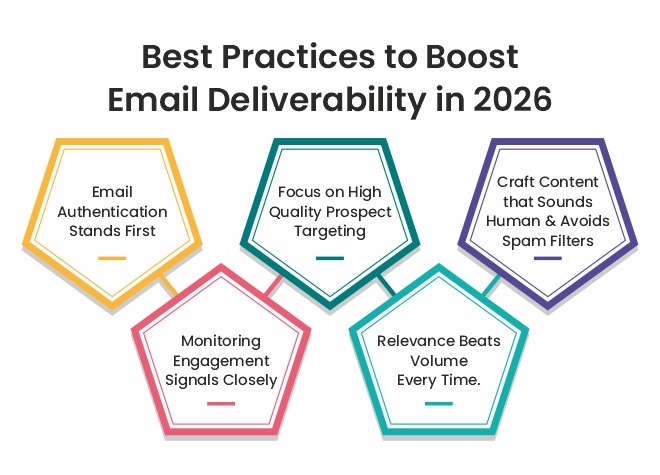 Best Practices to Boost Email Deliverability in 2026
1] Email Authentication Stands First
One of the most important steps in mastering cold email deliverability is implementing proper technical authentication. In 2026, authentication is no longer an option, mainly for bulk campaigns. Email providers place heavy emphasis on authentication indicators to determine whether an email should be placed.
Without it, even well-written and highly personalized emails are likely to land in spam folders, damaging sender reputation and campaign performance.
The following authentication protocols should be taken into consideration by businesses:
SPF (Sender Policy Framework):
Authenticates that your domain allows certain mail servers to send e-mail on its behalf.
DKIM (DomainKeys Identified Mail):
This system adds a digital signature that proves the email contents have not been modified in transit.
DMARC (Domain-based Message Authentication, Reporting, and Conformance):
DKIM and SPF are both consistent, and email security is offered with reporting and policy enforcement.
Google has already announced that emails from domains that are not properly authenticated by SPF, DKIM, and DMARC will most likely be filtered into spam. Following such protocols, consistent sending domains, and warming up new email accounts will help build trust with mail providers and go a long way toward improving deliverability rates.
2] Focus on High-Quality Prospect Targeting
Before sending an email, make sure to spend time on research. Sending cold emails to poorly researched or irrelevant prospects can lead to lower engagement, higher bounce rates, and spam issues.
Alternatively, targeted email outreach improves response rates and delivers standout results.
Before you hit the send button, make sure to research the prospect’s industry, role, interests, and pain points so you can personalize emails, increasing the likelihood of engagement.
Highly targeted emails signal to inbox providers that recipients find your content valuable, improving overall deliverability performance.
3] Craft Content that Sounds Human & Avoids Spam Filters
People ignore cold emails like anything. If the first line and the subject look typical of sales-focused, algorithm-written content, they would simply delete it.
Alongside over-optimized emails with fancy words, offers, and forced personalization, they don’t make it great in 2026; they can be easily spotted.
What works best?
-
Simple tone with personalization
-
Avoid spam cues such as excessive punctuation, ALL CAPS, risky attachments
-
Getting to the main points quickly
-
Focusing on relevance, rather than volume
-
Following human-like sending patterns
This doesn’t mean being sloppy or unprofessional. It means writing the way you’d speak if you were reaching out one-to-one.
4] Monitoring Engagement Signals Closely
The use of engagement measures is an important determinant of cold email deliverability.
Email service providers analyze recipients’ response rates to your messages, including opens, replies, clicks, bounces, and spam.
High engagement increases sender reputation and inbox placement, and low engagement can damage domain credibility within a short time.
Businesses in 2026 should track performance regularly and respond promptly to maintain healthy email deliverability.
Some of the core metrics to be tracked
Core Metrics:
Monitor inbox placement, open rate, bounce rate, complaint rate, and Gmail Postmaster spam rates regularly.
Maintain List Hygiene:
Remove inactive or unresponsive contacts from your list.
Run Placement Tests:
Conduct tests across Gmail, Outlook, and Yahoo to detect spam triggers and blacklist risks.
5] Relevance Beats Volume Every Time
Relevance has become the final deliverability advantage in 2026. The modern age spam filter considers engagement way beyond open rates.
Failure to respond, or not responding to your emails, by recipients rapidly lowers your sender’s reputation with inbox providers.
Sending more emails does not improve performance; on the contrary, in most instances, it accelerates the delivery of harm.
Effective cold email outreach is now about accuracy and not volume.
Successful campaigns are based on:
-
A strong focus on Ideal Customer Profiles (ICPs)
-
Shorter and more tightly focused lists of prospects
-
A message that provides the most important answer to the key question: Why you, and why now?
Overall, what matters today is relevance and volume!
Wrapping it Up!
Cold email deliverability in 2026 is different! Trust, personalization, and authenticity are the key factors to focus on.
AI and automation may help with outreach scaling, but human-oriented messaging remains necessary.
Deliverability isn’t a one-time fix; it’s a constant process!
The above-mentioned practices would certainly help launch a successful campaign.
At CandorWorks, we’ve got you covered with the right email deliverability approach, so you can focus on scaling outreach while we ensure your messages reach the right inboxes.