2025 became a defining year for how CandorWorks generates and converts B2B demand. Rapid AI adoption, the shift toward a cookieless ecosystem, and increasingly buyer-led, self-service journeys didn’t just change tactics; they changed the game. They required a fundamental rebuild of how demand engines operate.
At CandorWorks, results came from moving decisively away from volume-heavy outreach toward intent-led execution. Our approach centered on first-party data, AI-driven personalization, and tightly aligned Account-Based Marketing (ABM) embedded directly into sales workflows.
Across live programs, we consistently saw AI improve conversion efficiency, email remains the strongest ROI channel, and LinkedIn continues to outperform as the primary B2B social platform. However, this only worked when relevance, timing, and content quality were orchestrated across coordinated, multi-touch account journeys.
Buyer behavior also shifted rapidly. A growing share of B2B buying journeys now includes AI-assisted research, raising expectations around speed, accuracy, and frictionless experiences. Lead generation moved from “doing more” to “executing better.” At CandorWorks, the programs that performed best unified data, automation, and AI into a single operating model built for precision and repeatability.
1. Market Context: Why 2025 Forced a Reset
Several forces converged in 2025, making it one of the most disruptive periods CandorWorks has seen in B2B demand generation.
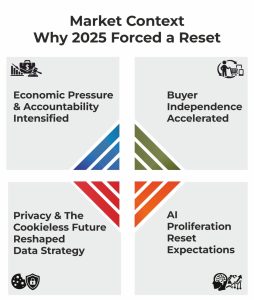 Economic pressure and Accountability Intensified
Marketing teams were expected to show direct pipeline contribution while operating under tighter budgets. While lead generation remained a top priority, increased investment in lead-gen technology signalled a shift toward efficiency and impact. At CandorWorks, every program was evaluated against pipeline influence, not lead volume.
Buyer Independence Accelerated
B2B buyers are increasingly self-educated before engaging with vendors. They consumed content, validated solutions through peer networks, and entered conversations later in the funnel. Linear funnels, heavy gating, and batch-and-blast campaigns consistently underperformed. Programs had to adapt to buyer-controlled journeys rather than force predefined paths.
Privacy and the Cookieless Future Reshaped Data Strategy
CandorWorks accelerated the transition to first-party data capture through forms, webinars, content hubs, and CRM enrichment. Third-party tracking gave way to consent-driven identifiers, improving both compliance and signal reliability.
AI proliferation Reset Expectations
AI-enhanced targeting, qualification, content relevance, and sales productivity became operational necessities. Across CandorWorks programs, AI delivered measurable lifts in conversion and qualification, proving its role as core infrastructure, not an experimental layer.
2. What Changed: Strategy, Data, and Channel Evolution
First-Party Data Became Non-Negotiable
As third-party cookies declined, first-party data became the foundation of CandorWorks’ execution model. Every capture point—forms, landing pages, gated assets, live interactions—was audited and optimized for both consent and intent depth. By unifying CRM data with behavioral and engagement signals, CandorWorks improved segmentation accuracy, personalization depth, and attribution confidence. This shift directly strengthened qualification quality and downstream conversion performance.
AI Shifted from Tool to Infrastructure
AI moved from a standalone capability to becoming embedded across the entire CandorWorks demand engine. This included predictive scoring, adaptive content, intent modelling, email optimization, and workflow automation.
In execution, this consistently resulted in:
- Higher conversion efficiency
- Stronger email engagement
- More accurate lead prioritization
On the buyer side, AI also become part of evaluation behavior. Programs designed by CandorWorks to reduce friction and deliver clarity close faster, compressing sales cycles and improving pipeline velocity.
ABM Matured into a Revenue Engine
ABM evolved from experimentation into a core CandorWorks go-to-market motion. As adoption matured, intent data, account hierarchies, and buying-group dynamics were unified to deliver relevant, role-specific experiences across target accounts.
Execution focused on:
- Stakeholder-specific content journeys
- Targeted event and content invitations
- Role-based value and ROI narratives
This approach materially improved sales-marketing alignment, increased close rates, and clarified multi-touch attribution at the account level.
Content Quality Became a Competitive Advantage
Generic content stopped converting. Buyers responded to credible, experience-backed insights. At CandorWorks, content that demonstrated real-world understanding consistently outperformed surface-level messaging across engagement and conversion metrics.
Formats that repeatedly delivered results included:
- Original research and benchmarks
- Case studies tied to measurable outcomes
- Interactive tools and assessments
- Short-form expert video
When paired with owned media and community distribution, these assets created durable, compounding demand rather than short-lived spikes.
3. How AI Added High-Value to the Demand Engine
AI is no longer limited to the top of the funnel. It now underpins the entire lead generation lifecycle at CandorWorks. In execution, it made demand engines faster, more predictive, and scalable without sacrificing quality.
Smarter Audience Selection and Targeting
AI models analyzed historical engagement across CandorWorks campaigns and publications. This surfaced patterns around titles, company profiles, and industries most likely to convert. This proved especially effective when ICP definitions were broad.
This enabled CandorWorks to:
- Prioritize high-intent segments
- Refine title mappings
- Reduce wasted reach
- Expand into whitespace with control rather than guesswork
Topic Suggestions and Content Relevance
Using NLP and engagement data, AI surfaced topics aligned with real audience behavior and emerging trends. This ensured content was built around demonstrated interest, improving engagement depth and conversion likelihood.
Data Quality and Lead Hygiene
Agentic AI automated deduplication, validation, and enrichment across multiple layers. This included email behavior, domain signals, and historical engagement patterns.
AI-based anomaly detection flagged low-quality submissions for manual QA. This significantly reduced rejection rates and improved delivery confidence for CandorWorks clients.
Spam and Bot Detection
Behavioral scanning identified spam, bots, and anomalous submissions early. This ensured only genuine leads entered the pipeline and preserved campaign integrity.
Content Curation and Automated Page Design
AI-supported personalized content curation across landing pages and emails. Prompt-based CMS workflows reduced design cycles while maintaining consistency and improving user experience.
Behavioral Data Analysis and Lead Categorization
By analyzing engagement depth and behavioral signals, AI helped CandorWorks identify lead personas and intent levels. This enabled more precise segmentation and message alignment.
Campaign Insights and Optimization
AI correlated engagement metrics with conversion actions such as downloads. This revealed which segments were truly intent-driven.
This allowed CandorWorks to:
- Scale high-performing segments
- Correct underperforming areas
- Rebalance TAL and whitespace strategy
At this stage, AI became central to delivering better leads, faster pipeline movement, and predictable outcomes.
4. What Actually Worked in 2025
Hyper-Personalized Content Orchestration
Personalization evolved from tokens to contextual relevance.
This included:
- Vertical-specific assets
- Adaptive landing experiences
- Role-aware email journeys
When powered by intent signals, AI-driven personalization consistently improved ROI and conversion efficiency across CandorWorks programs.
Modern ABM: Real-Time and Multi-Threaded
High-impact ABM programs leveraged real-time intent, firmographics, and technographics. This enabled simultaneous engagement of entire buying groups. AI-assisted execution shortened sales cycles and improved ROI at scale.
First-Party Data Programs That Scaled
Webinars, roundtables, micro-events, and owned communities became scalable opt-in engines. Preference centers and transparent consent frameworks improved trust. This enabled reliable multi-touch attribution.
Email Remained the Top Conversion Channel
Email continued to outperform when executed with intent.
- Automation improved engagement.
- AI-driven segmentation lifted opens and CTRs.
Plain-text, value-first sequences consistently outperformed generic drip campaigns.
LinkedIn Stayed the B2B Social Backbone
When used deliberately, LinkedIn delivered significantly higher conversion rates.
What consistently worked included:
- Short expert videos addressing high-intent questions
- Insight-driven thought leadership
- Event-led and peer-driven discussions
Interactive and Video Content Outperformed Static Assets
Interactive formats and short-form video consistently outperformed static PDFs. Video influenced buying decisions across funnel stages. This made it a high-leverage asset.
AI-Driven Lead Scoring and Qualification
Predictive scoring improved prioritization and routing accuracy. The strongest results came from combining AI recommendations with SDR and AE feedback loops.
Owned Media and Community Became Strategic Assets
Content hubs, newsletters, podcasts, and private communities reduced platform dependency. This created long-term demand continuity.
5. Tools & Tech Stack: The Solid Infrastructure Behind Precision
In 2025, execution quality was strongly dependent on the tech stack supporting it.
CandorWorks focused on a unified demand generation tech stack. This stack was built around integrated tools to activate first-party data, AI-driven orchestration, and account-level visibility. CRM served as the solid system of record. It was enriched by consented behavioral, firmographic, and intent signals unified through marketing automation and ABM platforms.
AI, the key pillar, was embedded across:
- Scoring
- Personalization
- Data hygiene
- Analytics
This enabled faster activation, cleaner data, and more predictable pipeline growth without increasing operational complexity.
6. Selling to Buyer Groups in ABM
Account-Based Marketing at CandorWorks was executed around buying groups instead of individual leads. This reflected the real-time view of modern B2B decision-making. Programs were designed to engage the entire stakeholder ecosystem within every target account. This was done through coordinated, role-specific messaging across channels.
AI and real-time intent signals allowed multi-threaded outreach. This perfectly synchronized timing, relevance, and content delivery across every stage of the buying journey. No critical stakeholder was left unaddressed. This approach greatly reduced deal friction and improved consistency in deal execution across sales and marketing.
Why This Mattered
By shifting focus from leads to buying groups, CandorWorks transformed ABM into a true revenue engine rather than a targeting tactic.
7. Compliance & Data Privacy
CandorWorks consistently followed a privacy-first growth framework. Compliance and data privacy remained foundational to its lead generation approach. This directly strengthened buyer trust. Every program was built on consent-first data collection. Sensitive information was handled securely. Purpose limitation was clearly defined.
Privacy principles were applied across data collection, AI usage, and activation. This ensured regulatory standards alignment without compromising performance.
Key Highlights
- Aligning with global privacy regulations, including GDPR and CCPA
- Data usage with purpose and transparent disclosures
- Role-based access controls and encryption across systems
- AI workflows are governed to prevent sensitive data exposure or misuse
- Trust and data integrity are preserved across the full demand lifecycle
What Stopped Working
- Volume-based cold outreach
- Over-reliance on third-party data
- Linear funnels and heavy gating
The CandorWorks Winning Formula
Insight × Relevance × Timing → Pipeline & Revenue
Powered by First-Party Data + AI Orchestration + ABM Alignment
Looking Ahead to 2026
CandorWorks expects continued acceleration in:
- AI-native go-to-market execution
- Buyer experience as a primary growth lever
- Community-anchored demand generation
- Unified brand and performance measurement tied directly to revenue
Conclusion
B2B lead generation now operates under a different set of rules. Single-channel tactics, generic messaging, and volume-driven execution no longer deliver sustainable outcomes.
In 2025, CandorWorks achieved the strongest results by combining AI, automation, first-party data, and tight sales alignment into a unified operating model. This is the approach now defaulted to. It is designed to scale quality, accelerate the pipeline, and deliver a predictable revenue impact.